Fresh! March 10, 2026
This post is based on a "Baseball in Japan" presentation I've made for an anime convention—available here in Polish. This might still be a work in progress.
✧✧✧
Beginnings
It is believed that baseball was introduced to Japan by American Christian missionaries. Horace Wilson, a teacher at (what is now) Tokyo University, familiarized his students with the game in 1872, when American baseball was still growing in the country of its origin. This was during the Meiji period, when Japan was striving to modernize and build business and political ties with the United States and Europe.
Before baseball became popular in universities, Japan didn't really have a word for "sport". They had many disciplines that originated from military training, such as sumo or kendo, but nothing that was played for pure entertainment or healthy competition.
But despite that, or maybe because of that, baseball really took off.
.jpg)
Babe Ruth in Japan [source]
In 1934, more than 500,000 Japanese attended a tour by American Major League Baseball (MLB) stars, including Babe Ruth, a legend of the sport. Back then, the MLB destroyed the Japanese teams, winning all 18 games.
Everything was wonderful... well, until a certain point.
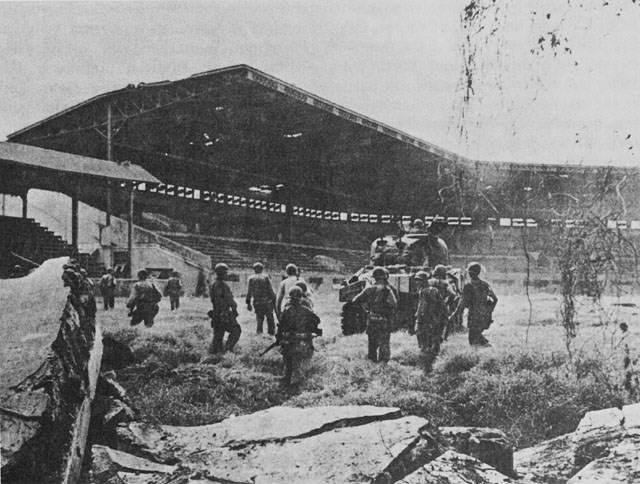
The assault of US Forces against the Japanese Imperial Army during the World War II at the Rizal Memorial Baseball Stadium [source]
"[Japan] was really never converted to baseball….[The Japanese] may have acquired a little skill at the game, but the soul of our National Game never touched them. No nation which has had intimate contact with baseball as the Japanese could have committed the vicious, infamous deed of December 7, 1941. if the spirit of the game ever had penetrated their yellow hides."
American Sporting News, 1941
Between 1940 and 1945, the English language was pushed out of public places, government organizations, and everyday life in Japan. During that time, baseball became known as 野球 (yakyuu, literally “field” and “ball”), and this name is still used today. Most other terms from the game have reverted to their English equivalents. [source]
After World War II and during the US occupation of Japan, baseball made a comeback. Just two months after the signing of the surrender in Tokyo, an exhibition game was played. General Douglas MacArthur, the military governor of Japan, saw the game as a way to boost morale and distract the Japanese population.
Today, baseball in Japan is doing better than ever. It is the most popular sport in the country, which is also reflected in pop culture (how many baseball mini-games did you came across?).

Yakuza 6 baseball minigame [source]
Speaking of modern times, it is difficult to talk about Japanese culture without mentioning one person... He has been the most popular Japanese athlete for many years in a row, leaving stars such as Yuzuru Hanyu or Yuki Ishikawa waaaay behind in popularity rankings. I'm talking about a person claiming 29.1% of votes, with the 2nd place getting merely 3.6%. [source]
Shohei Ohtani.

Shohei Ohtani on a TIME magazine cover [source]
Born in Japan, currently playing (or rather killing it) in MLB.
Try going to Japan without seeing his face on onigiri, tea bottle, shoe, perfume, watch, airline, or bank advertisements... It's just impossible.
More than a Sport
Baseball in Japan is, above all, a way to learn discipline, show character, and grow as a person. Sometimes you can even find the term yakyuudo—it's a combination of yakyuu (baseball) and do, literally meaning “the way of baseball”, similarly to kendo ("the way of the sword") or judo ("gentle way").
Collectivism
Baseball in Japan prioritizes the team over the individual. Tactics that have a negative impact on the individual player's results (like bunting), but give the team a chance to score, are commonly used.
Similarly, the experience and opinion of the coach is always of utmost importance. Just as age hierarchy matters at school or in the workplace (senpai–kohai system), it is the same on the field.
Fighting spirit
Injuries can be perceived as weakness or laziness, which can be remedied with more training. There have been cases where pitchers refused arm surgeries because “a man should throw until his arm falls off” - quoting Choji Murata, who struggled with his arm for a year and a half, eventually becoming unable to even lift it above his shoulder, before agreeing for a surgery. After the operation,Choji came back in better shape than he ever was.[source]
Accepting “voluntary” training sessions with a smile on his face, playing despite injuries and fractures, or leaving dying family members—just like Sadaharu Oh famously did, skipping the funeral of his own father[source]—has historically been viewed positively by society.
Discipline

Players wearing masks attend the National High School Baseball Championship's opening ceremony at Hanshin Koshien Stadium in Nishinomiya, Hyogo Prefecture, on Aug. 10, 2021 [source: Mainichi/Kenji Ikai]
High school teams resemble mini-armies, with coach being the absolute authority. Players who want to take baseball seriously in high school are expected to live in dormitories (to be as close to the field as possible), shave their heads, and train for 10 hours every Saturday and Sunday.
"If the players do not try so hard as to vomit blood in practice, then they cannot hope to win games. One must suffer to be good."
Suishu Tobita, head coach of the Waseda University team in the 1920s
Interestingly, an “unusual” phenomenon was observed during the pandemic. To the surprise of managers, their players showed a significant improvement in performance despite the reduction in formal training. Young players not only achieved greater throwing speed and range, but also gained muscle mass compared to what they would have achieved under the rigorous diet and training required by school programs.[source]
Truly a mystery!
High School Tournament
"Koshien is a sacred place."
The high school tournament has been held since 1915. During that tournament, the professional team that normally plays at this stadium—Hanshin Tigers—is moved to another one.
The high school tournament takes place from the beginning to the end of August. Every year, around 4,000 teams from across the country compete for a place in this competition. Only one team from each prefecture qualifies (except Tokyo, which is divided into East and West). Since 2021, high school girls' teams have also been holding their finals at this stadium.
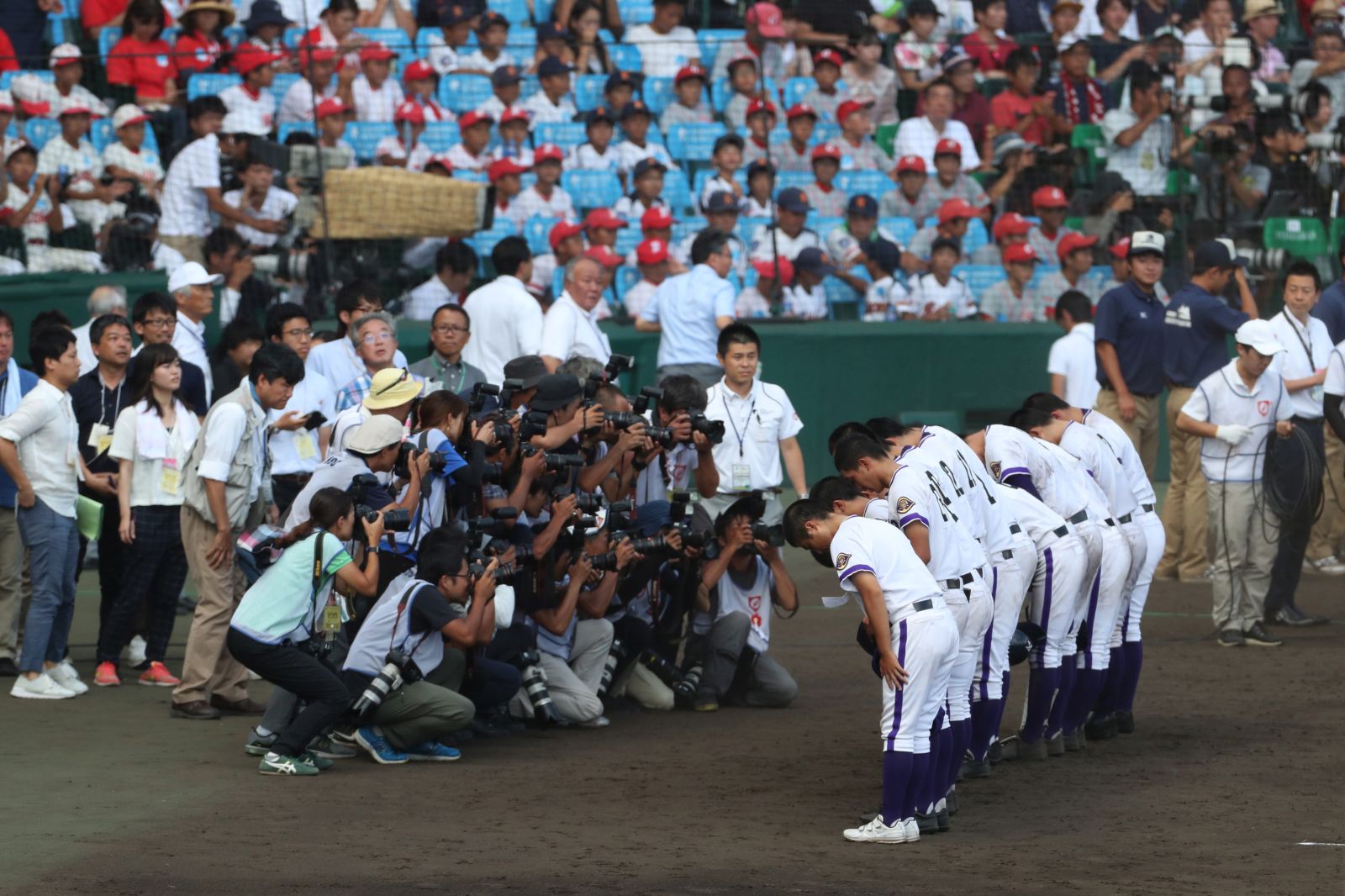
Koshien Players bowing for spectators [source]
One loss means elimination from the tournament. The stakes are high! This tournament is extremely popular and broadcasted on TV—winning it is the goal of a lifetime for most players. Those who make a name for themselves have a great chance pursuing a professional career. Just getting to Koshien can be seen as prestigious and can open some doors later in life.
Hey, did I mention that the average temperature during this tournament is over 30 degrees Celsius (86F)? Just to make things easier.
Although professional teams usually have uniforms of different colors, high school students mainly wear shades of white and gray.
“We are attracted to the innocence that is lacking in the adult world.”
Quote from the “Koshien: Japan's Field of Dreams” movie
In the 2014 semifinals, Taiga Matsui pitched 709(!!!) times in 50(!!!) innings. The game lasted four days. By comparison, in the same year in America, a high school student's performance of 194 pitches was met with disbelief. Even professionals don't throw more than ~120 times in a single game, and then they have several days to recover.[source]
“That game was the most physically difficult of my entire career, but I showed my fighting spirit,” said Matsui. He could have become a professional player in his country, but after that competition, he never regained full mobility in his arm.
Professional teams
There are two leagues in Japan—Central and Pacific. Each league has six teams, for a total of 12 professional teams. There are also women's teams, although they no longer have their own official league. The national women's team has consistently ranked first in the world since 2011.
New players cannot choose their teams; they participate in a yearly draft, where the managers choose the players they want.[source] If several teams are interested in the same promising newcomer, the decision is decided by lottery—player's opinion isn't taken into account on any stage of this draft.
At the beginning of their careers, players are expected to live in shared dormitories to bond with the team.
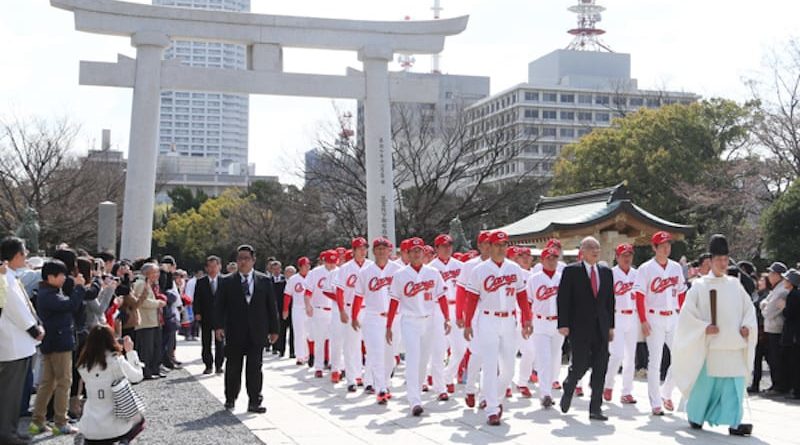
The Hiroshima Carp players, manager, owner and staff made their annual visit to Gokoku-jinja Shrine to ask the gods to bestow success on them in the 2016 season [source]
Teams in Japan begin their spring training on February 1, while players in America have three more weeks off. The rules are still strict, although players are allowed to grow their hair (and sometimes even dye it!) and have facial hair.
There were cases where some managers forbade their players from, for example, reading manga, because “it damages their image,” called them at night to make sure they were at home, or even gave them a sex ban to “conserve energy”…
Yeah. Even the players' wives complained about that last point.
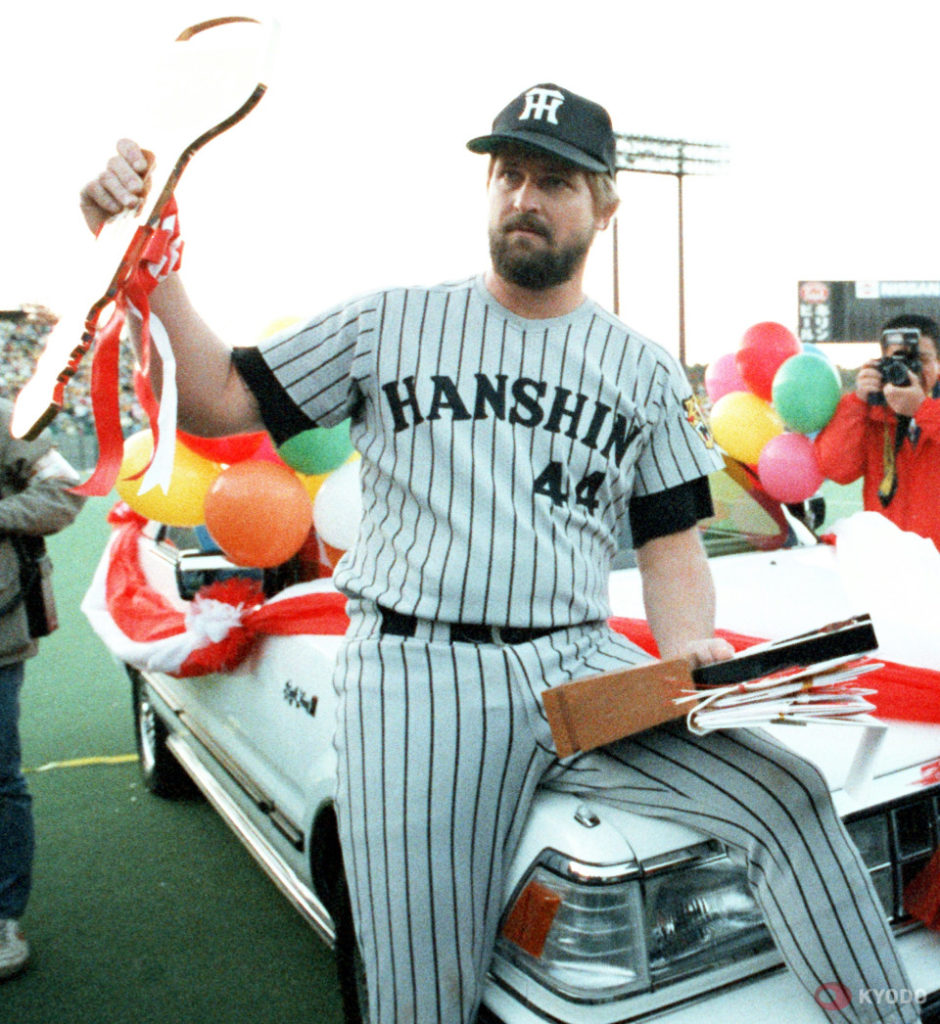
Randy Bass, a loved Hanshin Tigers slugging first baseman [source]
A total of four players from outside Japan are allowed on each team. These are usually, but not always, "mature" MLB players. Due to the cult of grueling training, which is unheard of elsewhere, and other cultural differences, many of these players have a rather difficult time in Japan (watch Mr. Baseball!).
Some companies have their own teams as a form of brand promotion—it's called Industrial Baseball.[source] Players are employed on a full-time basis and receive pay just like regular office workers. The best of the players also have a chance of being selected by a professional team—Hideo Nomo is a popular example.
Attending the game in Japan
Cities can be very proud of their teams. You can spot everything from special manholes, people on the street (sometimes also shop employees) wearing their favorite players' jerseys, to games being broadcast in restaurants.
Tickets start at around $7. Depending on the stadium, they can be a little tricky to buy for an outsider.
To some stadiums, you can take your own food and drinks (including ALCOHOL!). If you don't bring anything with you, there are plenty of cheap options available during the game —from udon, through KFC, to ice-creams. And, of course, there will be uriko—beer girls, ready to serve you a highball without the burden of leaving your seat.
And they are really really cute!
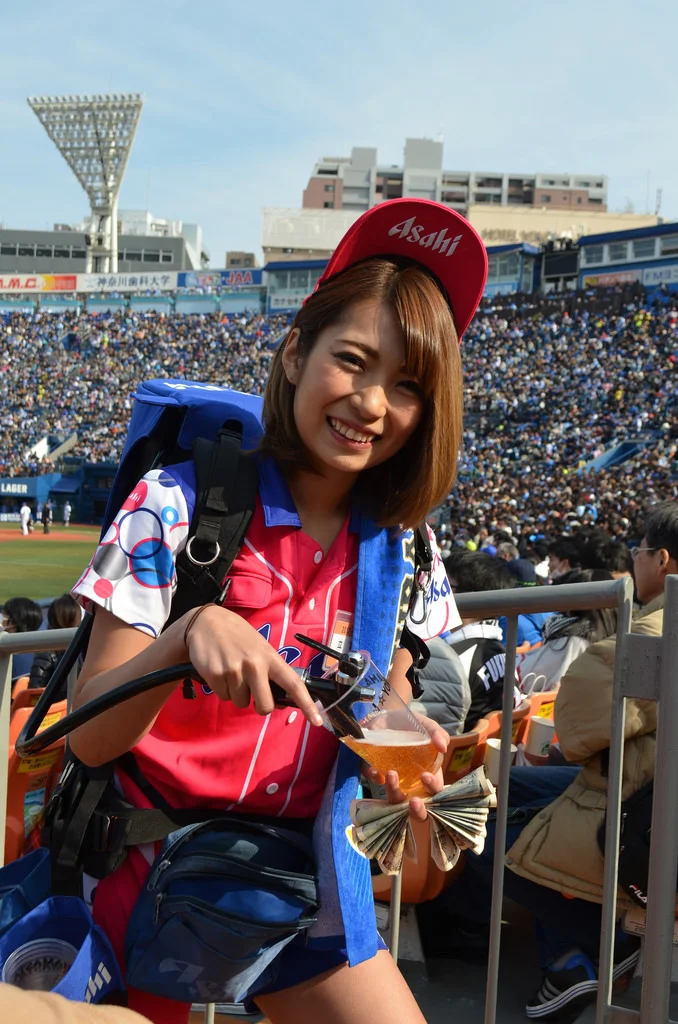
See? [source]
Before the game begins, official bands and cheerleaders, mascots, small events, and fan-cams entertain everyone coming early.

Maiko throwing the first pitch, photos by Yoshiki Yamada [source]
The game officially begins with the first ceremonial pitch thrown by invited person—this person can be anyone famous, or just a kid winning a lottery. The batter from the guest team attempts to “hit” their pitch, but never actually hits it.
Fans are of all ages and genders. There is a pleasant, family-friendly atmosphere during the whole game. Booing opposing teams or any form of aggression is unheard of. The most dedicated fans (Ōendan) have their own small sections, where fans wearing the opposing team's merchandise are not allowed to enter. They make the most noise during the game—only when their team is attacking, of course!
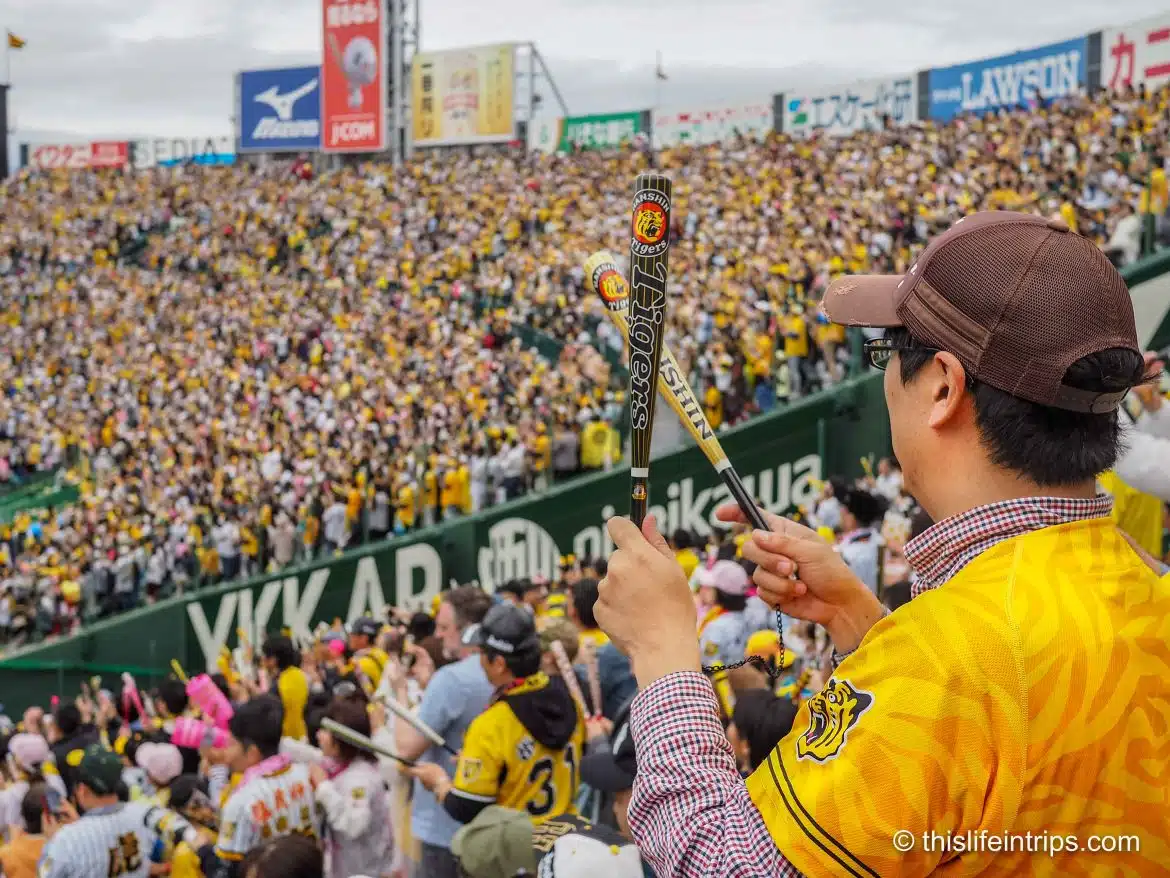
Hanshin Tiger fans cheering [source]
Mini-bats are a popular gadget for everyone. They are used to beat out a rhythm appropriate to the situation on the field. Some players have their own unique songs, and the arrangement may require not only the right rhythm, but also sitting down and standing up in a particular way.
During the lucky seventh inning, the teams' anthems are played, followed by a simultaneous balloon release.
Overall, it's super fun!
OK, I'm in. Where to watch a Japanese baseball game overseas?
Haha...
Well...
Unfortunately, it's not so easy. The best option to watch all the games you want is a combination of a VPN and a paid JSports subscription (please note, website and commentators are in Japanese only). Aside from that:
- Koshien (high school championship) is streamed for free every year, with games available to watch also after the live broadcast. The competition takes place from the beginning to the end of August.
- Some Japanese TV channels stream games – but of course you have to catch it live.
- プロ野球チャンネル パ on YouTube sometimes posts entire games, but they are from many years ago
At least we have Anime! Plenty of them!
If you don't know where to start, start with Ace of Diamons. It's like starting with Haikyuu for volleyball or Slam Dunk for basketball; it's just the anime for that, okay?
After that:
- for the atmosphere: Catch Me at the Ballpark!
- for some cool psychological action: ONE OUTS
- for the humor: Oblivion Battery
- for advanced fans: Major, Major 2, Cross Game, Touch
Still want more?
Gaijin Baseball is an excellent YouTube channel, and You Gotta Have Wa by Robert Whiting is a must-read. JapanBall is another good channel, though a bit more specific. I can also recommend Trevor’s Window into Japan and Baseball in Japan substacks.
On my to-read list is In the Japanese Ballpark: Behind the Scenes of Nippon Professional Baseball, which I have heard many good things about, and which should be one of the newest and most relevant publications on this subject.
And this video below is probably the best supplementary watch right now!